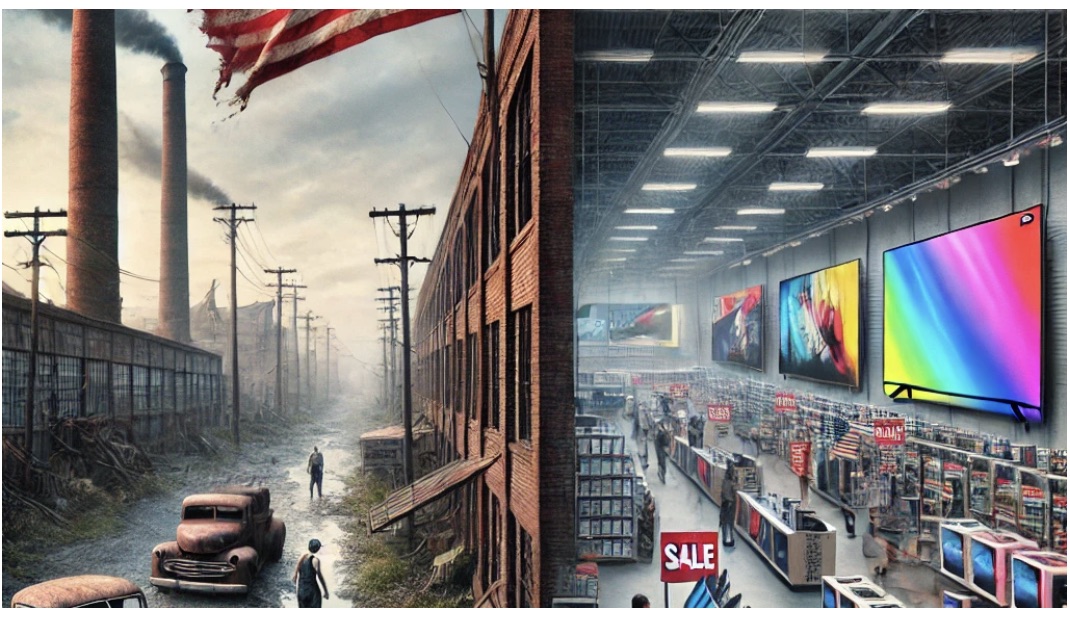
At the moment, the news cycle, political debate, and economic commentary are all focused on President Trumpʼs “reciprocal” tariffs, which are lots of things but certainly not reciprocal. But if you can get beyond the fallacies, misdirection, and economic sloganeering, you are left staring at a painfully real crisis decades in the making—the destruction of Americaʼs industrial heartland. Who bears responsibility?
Itʼs easy to point fingers at globalization, foreign workers, or automation, but this is a false narrative. If we are looking to honestly allocate responsibility, we need to put the blame squarely on ourselves. Corporate offshoring in pursuit of higher profit margins and consumption-driven Americans combined to hollow out a vital part of our economy.
Others have written about this before—including Charles Fishman, whose 2006 book “The Wal-Mart Effect” explored how the companyʼs size and purchasing power reshaped global supply chains and disrupted local economies. I use the term “Walmart Effect” not just as Fishman framed it, but in the broader sense of how corporate and consumer behavior together have transformed the American economy. Itʼs not just about jobs lost—itʼs about economic devastation, the destruction of the American dream for millions of Americans, the explosion in wealth and income disparity, and the political and social consequences that have followed.
The Hollowing Out of the U.S. Industrial Heartland The story of Americaʼs industrial heartland is, in many ways, the story of 20th-century prosperity. Cities like Detroit, Pittsburgh, and Cleveland were once booming centers of manufacturing, where a working-class family could build a solid life on the back of a factory wage.
Today, many of those same towns are shadows of their former selves—boarded-up storefronts, declining populations, and a deep sense of economic displacement. For decades, the dominant narrative has been that globalization is a tide that lifts all boats. By opening markets and shifting production to lower- cost regions, we were told, everyone would benefit—cheaper goods for consumers, higher profits for businesses, and overall economic growth.
And on paper, that story holds—global trade has expanded dramatically, corporate profits have soared, and consumers can buy more for less. But thatʼs not the whole story. Globalization, as pursued by corporate America, often came at the expense of domestic manufacturing jobs.
Plants were shuttered, jobs outsourced, and communities hollowed out— all in the name of efficiency. Meanwhile, the American consumer, lured by low prices, became a quiet accomplice in this transformation. The result has been a widening chasm between winners and losers in the modern economy—between those who profit from global trade and those whose livelihoods were sacrificed to make it possible.
This is the “Walmart Effect”—not a quiet tradeoff, but a creeping cancer. In pursuit of cheaper goods, American consumers—often unknowingly— traded good-paying, middle-class manufacturing jobs for minimum- wage, part-time positions at Walmart and other discount retailers. The short-term wins at the checkout aisle came at the cost of long-term economic security for millions of American families and the communities they once anchored.
The Corporate Shift: Profits Over People In the late 20th century, a new doctrine took hold in corporate America: prioritize shareholder value above all else. This shift led companies to aggressively cut costs, often by relocating manufacturing operations overseas to capitalize on cheaper labor markets. Countries like China, Mexico, and various Southeast Asian nations including Vietnam became prime destinations due to their lower wages and lenient regulatory environments.
This offshoring trend had profound consequences for the American workforce. Between 2000 and 2010, the United States saw a significant decline in manufacturing employment, with over 5 million jobs lost.[1] Iconic companies such as General Electric and Levi's moved substantial portions of their production abroad, leaving behind closed factories and unemployed workers. The rationale presented by proponents of offshoring was that it would benefit the U.S.
economy by lowering production costs and, consequently, consumer prices. However, this perspective often overlooked the long-term economic and social costs, including job displacement and community destabilization. Unsurprisingly, a 2004 report by McKinsey & Company encapsulated this narrow viewpoint: "Business process offshoring does not mean the US economy loses every time a job is sent to another economy.
Rather, it's a win-win game.” While this analysis highlighted potential macroeconomic benefits, it downplayed the immediate and localized hardships faced by American workers and their communities. The Role of the American Consumer While corporate America set the wheels of offshoring in motion, it was the American consumer who helped keep them spinning. As factories closed and good-paying jobs vanished, shopping malls and big-box stores thrived.
Nowhere was this more evident than at Walmart—a company that didnʼt just reflect the new economy, but helped shape it. In the span of a few decades, the American consumerʼs expectations shifted. Price became king.
Made in America gave way to Made in China, if it meant a lower dollar cost on the sticker. With stagnant wages and rising living costs, cheap goods offered a kind of economic relief—even if it was an illusion. The pursuit of cheaper goods also created massive demand for low-wage retail and service jobs.
The very people who had once earned a middle-class wage in factories were now scanning barcodes under fluorescent lights, often part-time, with no benefits. Consumers didnʼt act with malicious intent or even conscious indifference to the destruction of Americaʼs heartland. They acted rationally in a system rigged for low prices and high volume.
But the consequences were profound—a workforce de-skilled, communities stripped of their economic base and a national economy increasingly divided between low wage service workers and stockholders. Walmart If corporate outsourcing hollowed out the American industrial base, Walmart paved over the ruins and built a supercenter. What began as a single discount store in Arkansas became the worldʼs largest retailer by promising “Everyday Low Prices.” But those low prices came with hidden costs: shuttered factories, stagnating wages, and the normalization of precarious work.
Walmart didnʼt cause deindustrialization on its own, but it embodied and accelerated it. The companyʼs relentless focus on cost-cutting transformed the entire retail supply chain. Domestic manufacturers who wanted to stay on Walmartʼs shelves had two options: move production overseas or lose the account.
Many chose the former—and once the supply chains moved, they rarely came back. At the same time, Walmart and similar retailers reshaped the American labor landscape. They replaced unionized factory jobs with part-time, low-wage service positions.
The Bureau of Labor Statistics estimates that the average retail worker earns less than half of what a manufacturing worker did in 1980, adjusting for inflation. And fewer of those jobs come with health care, pensions, or the possibility of upward mobility. "Walmart has a unique system that benefits them while screwing over their employees and that system is to overwork them and underpay them..." [2] The “Walmart Effect”, then, is more than economic—itʼs cultural.
It normalized a race to the bottom. It framed the erosion of labor standards as a necessary price for affordability. And it shifted the American dream from earning a good living to scoring a good deal.
Socioeconomic Consequences The loss of manufacturing jobs created a social rupture. For generations, industrial work had been the backbone of Americaʼs middle class. These were jobs that didnʼt require a college degree but offered stability, dignity, and a path to upward mobility.
When they disappeared, they left more than empty factories behind. The rise of gig work, temp jobs, and retail employment marked a fundamental shift in how Americans experienced work—not as a career, but as a hustle. Entire communities began to unravel.
Towns built around steel mills or auto plants saw their tax bases collapse. Schools and public services deteriorated. Addiction rates climbed.
Young people moved away—or stayed and got stuck. In places like Flint, Youngstown, and Gary, the American Dream became something that used to live there. At the macro level, the consequences have been equally stark.
Income inequality in the U.S. has widened to levels not seen since before the Great Depression. Regional economic divides have deepened, with coastal cities booming while the industrial heartland stagnates.
And the political consequences—populist backlash, declining trust in institutions, and deepening polarization—can be traced, in part, to the dislocation and despair rooted in this economic transformation. This isnʼt just a story of lost jobs. Itʼs a story of lost identity, lost purpose, and lost faith in a system that promised opportunity but delivered austerity.
Conclusion The decline of the U.S. industrial heartland didnʼt happen overnight—and it didnʼt happen by accident. It was the result of a series of decisions—by corporations that chased cheap labor, by policymakers who cheered globalization without cushioning its blow, and by consumers who—often unknowingly—exchanged good jobs for cheap goods.
The “Walmart Effect” was never about just one company, or even one industry. Itʼs about the shift in American values—from production to consumption, from community investment to quarterly returns, from shared prosperity to individualized bargain hunting. That shift hollowed out towns, deepened inequality, and left millions to navigate an economy that no longer works for them.
In this context, the renewed political focus on tariffs may seem like a solution—but it is not. Tariffs are being sold as a cure for deindustrialization, yet their proponents are being disingenuous. They often conflate tariffs with trade deficits and promote a narrative of unfair trade that doesnʼt hold up to scrutiny.
The U.S. already imposes higher tariffs than most of its major trading partners, and many of the proposed new tariffs are not reciprocal—theyʼre punitive. The problems are real, but tariffs wonʼt solve them.
Whatʼs needed instead is a deeper reckoning with how we value labor, production, and community—and a more honest conversation about the choices weʼve made, and those we still face. Responsibility is shared. But so is the power to demand something better.
Rethinking the American economy means rethinking what—and who—we value. It means holding corporations accountable, but also confronting the uncomfortable truth that our own buying habits have consequences. The next chapter doesnʼt have to be one of further, steepening decline.
But it will require more than nostalgia—it will require intention, national industrial policy, education, increased income and wealth equality. It will require talented and thoughtful political leadership —which remains desperately needed and must be found somewhere if we want to rebuild our nation. [1] While manufacturing jobs declined sharply between 2000 and 2010, there was a modest rebound in the following decade due to factors like post-recession stimulus, rising offshore labor costs, energy-driven reshoring, and trade policy shifts.
However, these gains did not restore prior employment levels or reverse the broader trend of economic polarization. [2] Medium, August 2, 2020 “What Itʼs Like to Work At Walmart—Pre and Post Pandemic.”