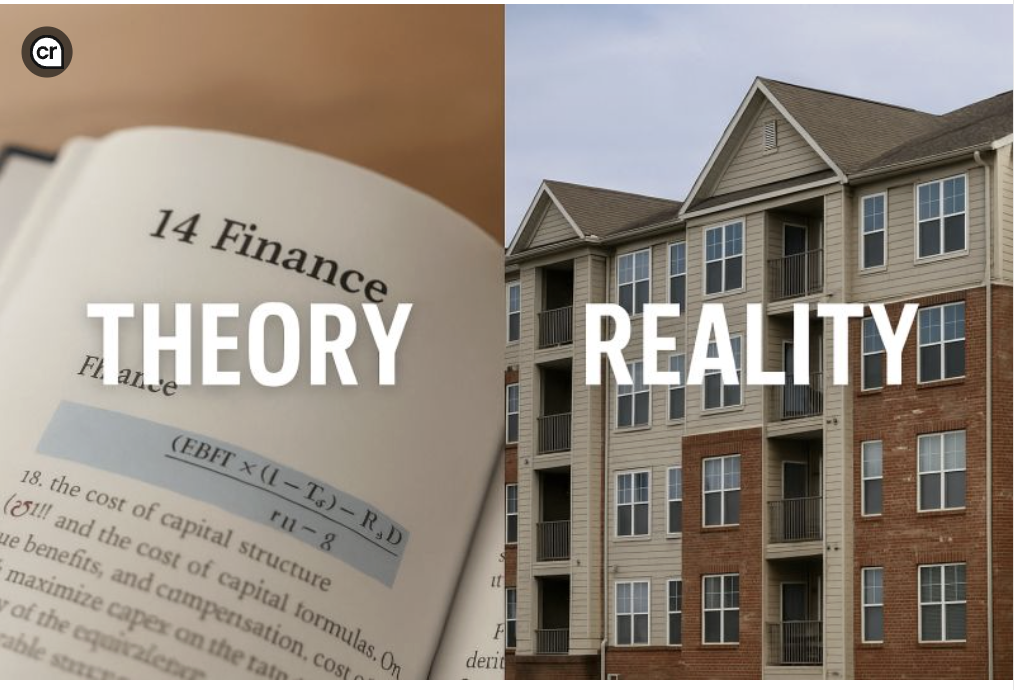
When finance theory meets leaking roofs...\ \ WHEN GREAT THEORY MEETS REAL-WORLD REAL ESTATE
Since I posted my article on cap rates several weeks ago, I came across an October 2024 paper by Professor Peter Linneman of Wharton Business School titled "Cap Rates and Treasuries: A New Perspective."\ \ With lots of genuine respect and admiration for both Wharton (I am a graduate of University of Pennsylvania Law School) and for Professor Linneman, it's a perfect example of why so much academic finance, while rigorous, is practically useless.\ \ Even Professor Aswath Damodaran of NYU --- one of the most respected voices in finance --- has often been critical of how much of the academic literature offers little practical value to practitioners. On this, I'm entirely in agreement.\ \ The logic in Linneman's paper is flawless: convert NOI to "cash-flow NOI," assume a constant low growth rate, plug it into the Gordon Growth model --- and voilà, cap rates align perfectly with valuation.\ \ The only problem? THAT'S NOT HOW REAL ESTATE ACTUALLY WORKS.\ \ -Practitioners don't convert NOI to "cash-flow NOI"\ -Growth isn't constant or low--it's cyclical, uneven and market dependent\ -Properties age. Maintenance capex rises just as rents flatten and new buildings enter the market.\ \ If you're going to make all those assumptions anyway, you might as well just run a proper DCF --- which, by the way, is a lot easier for real estate than for most operating businesses.\ \ \ Theory is elegant. But buildings leak, boilers fail, tenants move out, and interest rates move in unpredictable ways --- none of which fit neatly into a perpetuity model.